
Below, we share an article by the Dél-Dunántúli Gépipari Klaszter (South Transdanubian Machine Industry Cluster).
Source: https://ddgk.hu/2026/03/11/hogyan-lesz-az-otletbol-nyertes-eu-s-palyazat-gyakorlati-tapasztalatok-kkv-knak/
EU-funded projects can bring companies not only financial support, but also new connections, business opportunities and organisational development. Applicant companies become part of international professional and business networks, opening the way to new collaborations. Through joint projects, companies develop operational and project management practices that strengthen their competitiveness in the long run.
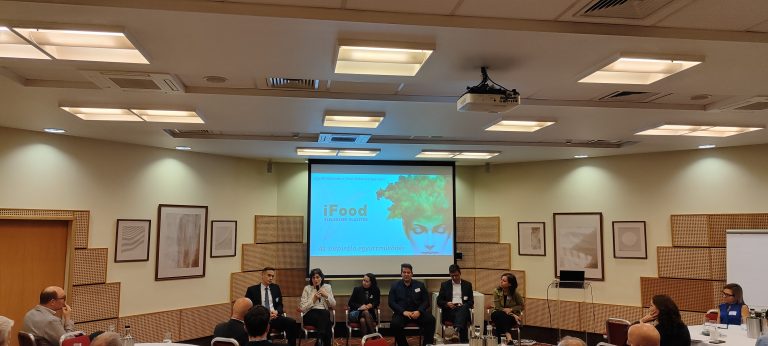
At the iFood Food Industry Cluster’s opening event of the year, industry players shared their experiences on digitalisation, Industry 4.0 and direct EU funding opportunities. One of the programme’s highlights was a panel discussion titled “EU projects from the inside – how does an idea become a winning application, and why is this good for a Hungarian SME?”, where Berta Szabó, manager of the Dél-Dunántúli Gépipari Klaszter, shared practical experiences from herself and her chamber colleagues.
EU grant applications are typically implemented in international consortia, where companies, research institutions and professional organisations from several countries work together. This allows businesses to become part of an international professional and business network that would otherwise be difficult to access, or difficult to build up on their own.
Smaller SMEs often join these partnerships by connecting to the project of a larger integrator company. Such projects not only expand the company’s network and strengthen its market position, but also have an impact on how the company operates as it implements a successful project: they introduce more structured processes, measurable goals and performance indicators, and strengthen a project management mindset within the organisation.
Participating in international projects requires preparation. It is important for a company to have a colleague who can take part in partner and consortium discussions and project work in a foreign language – typically English. Even the application submission stage requires significant time and attention. However, this initial investment pays off: once a company has prepared the necessary company and organisational presentations, technology and process descriptions, as well as project or research concepts, it becomes much easier to take part in further applications later on.
The chance of winning an international research and development grant is generally below 10%. This is partly due to strong competition, as the decline in domestic funding means more and more organisations are applying for international programmes. On the other hand, only innovations that are truly outstanding and have significant impact can receive support. It is therefore worth striving to meet the application’s evaluation criteria as closely as possible, and to try again even after initial setbacks.
Certain direct EU funding sources offer higher support intensities, while administration and the settlement process are becoming increasingly simplified, and project implementation follows transparent rules and predictable deadlines.
Experience shows that many organisations adapt their activities to whatever funding opportunities appear, rather than planning around long-term goals. This can generate revenue in the short term, but it is risky: if funding sources dry up, the company can easily be left without market revenue. Grant applications should therefore serve the company’s strategy – rather than looking for a project to fit a grant, it is better to find the right funding source for the project. The best possible project is one about which the company can say: “we would have done this even without the grant.”
Practical advice for businesses
Several steps can help businesses interested in EU grant applications succeed:
First, do your “homework”: strengthen your organisation, build a corporate culture, and define your strategy based on market needs. Only then look for funding sources – not the other way around.
Identify and protect your company’s key assets, including through intellectual property protection tools where appropriate.
Join the network of support organisations – for example the programmes of NKFIH (National Research, Development and Innovation Office), the National Innovation Agency, the Enterprise Europe Network, or the local chambers of commerce – and map out the funding opportunities relevant to you; ask these organisations for help (usually free of charge). Staff at the Pécs-Baranya Chamber of Commerce and Industry welcome enquiries at een@pbkik.hu.
Register on international partner-search platforms and start actively looking for project partners, e.g. Funding & Tenders, the EDF Partner Tool.
For businesses less experienced in the application process, involving professional grant-writing experts can also be a significant advantage.
Finally, it is worth mentioning that so-called cascade funding opportunities can be a good entry point into the world of EU projects. These are smaller-scale, more quickly accessible – often voucher-type – grants that allow companies to gain their first experience in international pilot projects.
2026.03.11.